The most common message we get from people considering a surf camp is some version of the same question: "I've never done this before — am I actually ready for it?" Sometimes it's "I tried surfing once on holiday and it was a disaster." Sometimes it's "I've always wanted to try but I don't know where to start."
Here's the honest answer: Morocco is one of the best places in the world to learn to surf. Not because it's easy — surfing is never easy — but because the conditions, the setup, and the coaching work well for people starting from zero. The beach breaks near Tamraght are sandy, consistent, and genuinely forgiving. There are waves year-round, and with the right spot selection from your coach, there are waves at the right size for your level in every season. A surf camp takes care of all the logistics so you can focus on learning.
This guide covers everything a first-timer needs to know: the right breaks, what your first lesson actually looks like, how fast you'll progress, and what a typical day feels like at Darna. If you're still deciding whether Morocco is right for you, start with our complete Morocco surf camp guide. If you're past that and trying to understand what beginner surfing here actually involves, read on.
Is Morocco Good for Beginner Surfers?
Yes — and specifically yes, not just "it's fine." There are a few things about Morocco's surf environment that make it particularly suited to first-timers.
Sandy beach breaks. The breaks near Tamraght are sand-bottom, not reef or rock. This matters enormously for beginners: when you fall — and you will fall, a lot — you're landing in sand, not on coral or rock. Falls are part of learning to surf. A sandy bottom makes them much less consequential.
Waves for every level, in every season. Morocco has real waves — not too weak, not unmanageably powerful. The key is coaching and spot selection. In spring and summer, the main breaks near Tamraght are naturally gentle and consistent for beginners. In winter, when bigger swell arrives, coaches move beginners to sheltered spots where conditions stay manageable. Either way, you're working with the ocean rather than fighting it.
The physical environment is welcoming. Warm air, clear water, long stretches of beach with room to make mistakes and try again. There's no crowd pressure at the beginner breaks. The coaches here have taught hundreds of first-timers, many of whom had never even been on a board. They know where the common problems are before you've made them.
One thing worth understanding about Morocco's surf calendar: the powerful winter swells that arrive from December to February make the point breaks challenging and genuinely demanding — but coaches don't send beginners to the point breaks in winter. When conditions are heavy, sessions move to sheltered beach breaks along the coast where the swell is filtered and manageable regardless of what Anchor Point is doing. This is what surf coaching in Morocco actually means: spot selection matched to both conditions and level. No month is closed to beginners. Spring and summer are the most comfortable and forgiving entry points — but if December or January are your only available dates, that's a workable trip. Our month-by-month guide breaks down exactly what to expect in each season.
The Best Breaks for Beginners Near Tamraght
Banana Point
Banana Point is the beach break closest to Tamraght and the one beginners spend most of their time at. It works across a range of swell sizes, and the character of the wave changes depending on where you position yourself on the beach. In smaller conditions — which is most of the year in spring and summer — the inside section produces soft, rolling whitewash that's ideal for pop-up practice. As you build confidence, the outside section of Banana Point starts to reveal itself: longer rides, more shape, an actual wave to read rather than just react to.
Panoramas
Panoramas sits a short drive along the coast and is another reliable beginner spot, particularly on days when Banana Point is a bit bigger than you're ready for. It's a gentle beach break with a consistent left that breaks softly enough to give you time to think about what you're doing rather than just surviving it. Less crowded than some of the better-known spots further north, it's a useful option when you want space and patience in the water.
The Agadir Beach Breaks
On bigger days, when even the gentle inside sections of the main breaks have more energy than a first-timer needs, Agadir's long stretch of sheltered beach offers calm, manageable conditions for drilling technique without being challenged by the ocean at the same time. These sessions are less exciting, but they're often the most technically productive — there's value in repetition on small, predictable waves when your pop-up is still inconsistent.
What Happens in Your First Surf Lesson
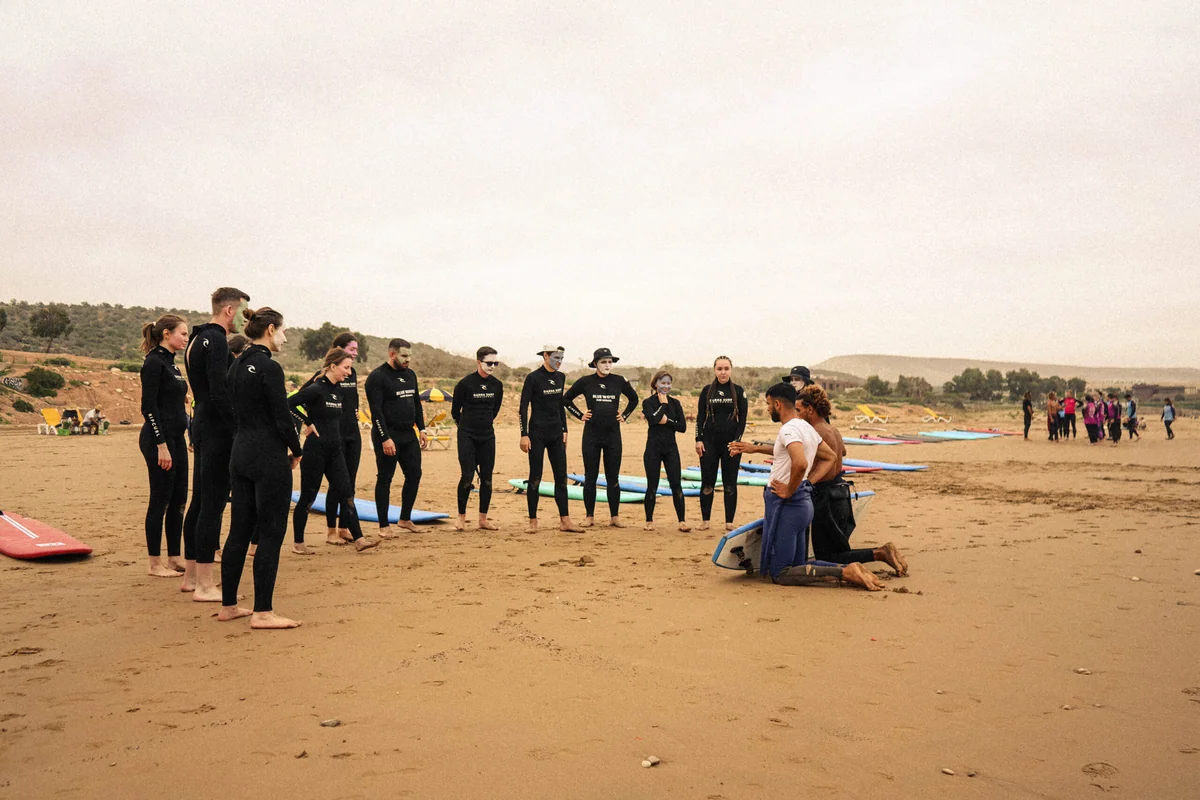
Your first session doesn't start in the water. It starts on the beach, on a board lying flat in the sand, learning the pop-up — the explosive move that gets you from lying on your stomach to standing with your feet positioned correctly on the board.
This sounds basic. It is basic. It's also the foundation of everything else you'll do on a surfboard, and getting it right in a low-pressure environment (dry land, no waves, no current) means you're not trying to figure out a mechanical movement at the same moment you're trying to balance on moving water. The coaches here are methodical about it because they know from experience how much difference a solid pop-up makes by day three.
Once you're in the water, the first few waves you catch will be in the whitewash — the already-broken part of the wave, which is rolling and soft and has very little power. The coach will be in the water with you, positioning you on the board, reading the waves, and telling you when to start paddling. You'll fall. You'll get back on the board. You'll fall again. And at some point — usually somewhere in that first session — you'll stand up and stay standing, and the feeling of it will make complete sense of why people keep doing this.
By the middle of your first day, you'll be catching whitewash waves on your own and working on staying on the board longer. By the end of it, you'll be tired in the specific way that surfing makes you tired — arms, shoulders, core — and you'll understand, physically, what you're trying to get better at.
How Fast Will You Progress?
Honestly: faster than you think, and more variably than any guide can promise. Here's what a typical week of learning to surf at Darna looks like for a complete beginner:
Day 1–2
Beach technique, whitewash waves, first successful pop-ups. You'll stand up. The timing will feel random. You'll fall a lot. You'll leave the water grinning.
Day 3–4
Starting to catch unbroken waves. Reading the ocean more consciously. Paddling becoming more efficient. The pop-up starting to feel less like a decision and more like a reflex.
Day 5
Selecting waves, paddling without being pushed, riding longer. Beginning to understand positioning on the board. First instinctive turns.
Day 6
Enough of a foundation to keep improving on your own. You know what you're trying to fix. You understand what a good wave looks like. You're a surfer.
Some people progress faster than this — people with good balance, strong paddling fitness, or prior experience in boardsports. Some progress slower. Age, fitness level, and anxiety in the water all play a role. A good coach adjusts to where you actually are, not where the schedule says you should be.
What Level Do You Need to Be Before You Arrive?
The short answer: none. A structured surf camp is specifically designed to take you from no experience to functioning surfer in a week. You don't need any prior surfing background to get a lot out of it.
The one requirement that isn't negotiable: you need to be comfortable in the water. Not a competitive swimmer — just genuinely at ease in the ocean, able to float and stay calm if a wave knocks you off your board. If swimming makes you anxious, the ocean environment will too, and that anxiety will slow your learning significantly. If you can swim 50–100 metres in open water without panic, you're ready.
Age and fitness are not barriers in the way people often assume. We've coached guests in their 50s and 60s who had a brilliant week. What matters more than raw fitness is willingness to commit physically during sessions and recover properly between them. The camps are structured around that: two surf sessions per day with plenty of time to eat, rest, and decompress in between.
If you have done a few lessons elsewhere before — on holiday, at a local surf school — that's useful but not necessary. The coaching here starts from the beginning regardless and builds at whatever pace makes sense for where you are.
A Typical Day at Darna
The structure of a day is deliberate. Surfing well requires energy, and the schedule is built around protecting your capacity to get the most out of each session.
7:30 am
Breakfast at the house. Proper food — eggs, bread, fruit, coffee. Not a rushed grab-and-go.
8:30 am
Drive to the beach. Boards, wetsuits, and equipment sorted by the team. Beach warm-up, technique check, then into the water.
8:45–10:30
Morning session. This is the priority window — offshore winds, quieter lineups, and the best-shaped waves of the day. Two hours of coached surfing.
11:30 am
Back at the house. Lunch, shower, rest. Video analysis of the morning session — watch yourself surf, understand what to work on.
3:00 pm
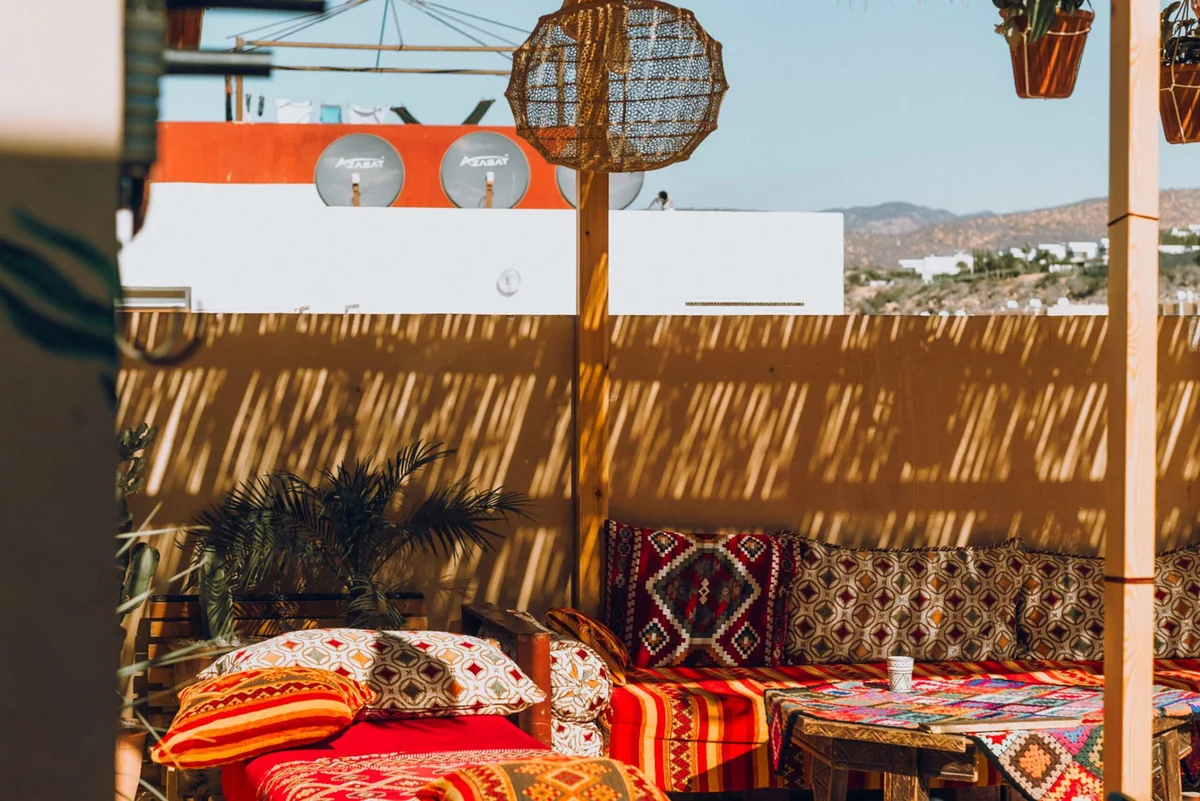
Optional afternoon session, or free time for an excursion, the souk, the hammam, or a yoga session on the rooftop. Not everyone does the afternoon water session every day — rest is part of the programme.
7:30 pm
Dinner together. The kitchen takes Moroccan cooking seriously — tagines, fresh salads, good bread. Everyone eats at the same time, which is where most of the actual connection happens.
Evening
Rooftop. Conversation. Early nights are common and completely acceptable — your arms will make sure of that.
For the full breakdown of what's included in the packages, including optional day-trip activities and the Surf & Yoga option, see the surf packages page.
What's Included — and What Isn't
Understanding what a surf camp actually covers before you arrive prevents a lot of confusion. Here's how it works at Darna:
Included in the Surf Stay Package
- Accommodation at Darna Surf House in Tamraght
- Breakfast, lunch, and dinner every day — all freshly prepared
- Daily surf coaching in small groups
- All surf equipment: boards suited to your level, wetsuits, leashes, wax
- Transport to and from the surf spots
- Video analysis sessions
- Airport transfers
Not Included
- Flights and travel insurance (always get travel insurance)
- Personal spending — souvenirs, restaurant meals outside the camp, local transport
- Optional excursions (Paradise Valley, camel trek, sandboarding, souk visit)
- Tips for coaching staff (entirely optional but always appreciated)
The Surf & Yoga Package includes everything above plus daily yoga sessions — at sunrise on the roof or at sunset, depending on the week's programme. If that sounds like your kind of week, it's worth looking at alongside the standard Surf Stay option on our packages page.
Getting Surf-Fit Before You Arrive
You don't need to prepare specifically for a surf camp the way you might for a running race or a mountain trek. The coaching team will work with wherever your fitness is. But if you want to arrive feeling ready rather than catching up, here's what actually helps:
- Swimming. More than anything else. If you can swim 20–30 lengths of a pool comfortably, your paddling will feel significantly less exhausting in the first two days. Surfing uses the same muscles — shoulders, upper back, and arms — and building that base makes the first sessions far more enjoyable.
- Flexibility and core work. A regular yoga or stretching practice helps, as does any core conditioning. The pop-up is a physically demanding movement done repeatedly across a two-hour session. Stronger and more flexible = fewer wasted attempts.
- Anything that keeps you on your feet. Snowboarding, skateboarding, wakeboarding, stand-up paddleboarding — any experience on a moving platform gives you a head start on balance. Not essential, but useful.
What you don't need to do: pay for surf lessons at home before you come. The most common patterns taught at beginner surf schools vary widely in quality, and re-learning technique from scratch with a qualified coach in the right conditions is usually faster than trying to combine prior lessons with new instruction. Arrive open and ready to learn from the beginning.
Frequently Asked Questions
I've never surfed before — is a surf camp right for me?
Yes. Morocco's beach breaks near Tamraght are among the most beginner-friendly in the world, particularly in spring and summer. Sessions are structured specifically for complete first-timers: beach-based technique first, then into the whitewash, then into small unbroken waves as your confidence builds. Most people stand up and ride their first wave within the first or second session.
What size surfboard will I be on?
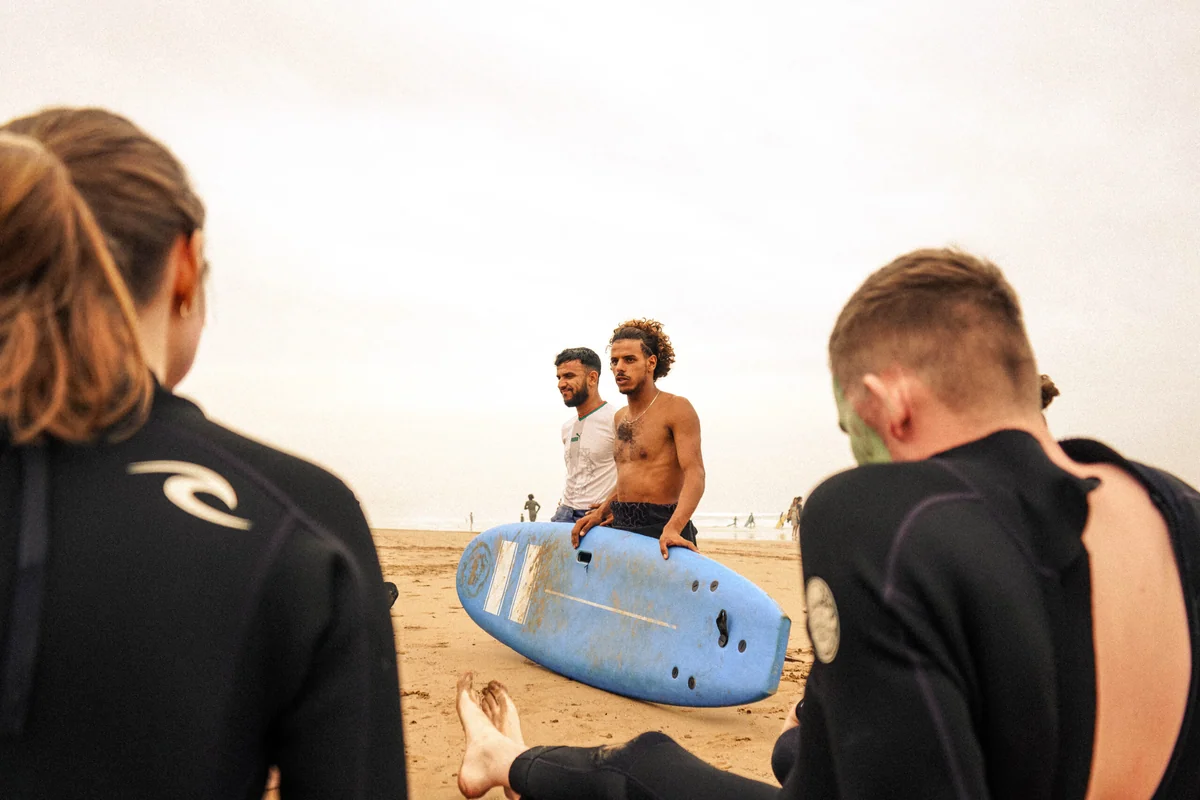
Almost certainly a foam longboard — also called a foamie or soft-top — somewhere between 8 and 10 feet long. These boards are wide, stable, and forgiving, which is exactly what you need when you're learning. As you progress through the week, your coach may move you to a slightly shorter board, but don't rush it. The foam board is there to help you succeed faster, not to hold you back.
Do I need to be able to swim well?
You need to be comfortable in the water — genuinely comfortable, not just able to stay afloat. You don't need to be a competitive swimmer, but if you're anxious in the ocean, that anxiety will make learning harder. If you can swim 100 metres in a pool without stopping, you have the base you need.
Do I need a wetsuit? Do I need to bring one?
In summer (June–August), a rash vest or thin shortsuit is all you need — the water reaches 22–25°C. In spring (March–May) and autumn (September–October), a 3/2 fullsuit is more comfortable. All wetsuits are included in the package. You don't need to pack one.
Will I be with other beginners or mixed with advanced surfers?
You'll be grouped by level. Beginners surf together at the beginner breaks, with a coach. Advanced guests surf separately at more challenging spots. You share meals, evenings, and the house — which is the best part of camp — but on the water, you're always at a spot and with a group matched to your ability.
Is Morocco safe for solo women travellers?
Yes. The surf community around Tamraght is welcoming and the camp format is well-structured — you're always in a group and never navigating unfamiliar situations alone. Solo women make up a significant portion of guests at Darna. The same sensible precautions that apply anywhere apply here, and in practice, guests rarely encounter anything that gives them pause.
Have more questions?
Visit our full FAQ page for everything from cancellation policy to what to pack. Or get in touch directly — questions about whether the camp is right for your level or your situation are exactly what we're here for.
Your First Surf Camp Starts Here
The question isn't really "am I ready?" The question is "what's actually stopping me?" For most people, the barrier to a surf camp is uncertainty — not knowing what it'll be like, whether they'll be the slowest person there, whether they'll feel embarrassed by how hard it is. The answer to all of those is: it's fine, you won't be alone in that, and the hard part is exactly what makes it worth doing.
Morocco, Tamraght, and a week in the water with people who know these breaks well is as good a starting point as surfing offers. When you're ready to look at what a week costs and what's included, the packages are here. When you're ready to book, the booking form is here. And if you want to talk through whether a specific week works for your level before you commit, we're easy to reach.
The waves are patient. Come when you're ready.