Morocco is one of the rare surf destinations that genuinely works year-round. The Atlantic never really turns off — there's always something rideable within reach of Tamraght, whether you're a complete beginner chasing your first wave or an intermediate surfer ready to push into faster, more powerful breaks.
But that doesn't mean every month is equal. The waves are different in October than they are in June. The crowds are different. The water temperature changes. The wind behaves differently in the morning versus the afternoon depending on the season. If you're trying to book a week that matches your level and your expectations, knowing what to actually expect each month is worth understanding before you commit to dates.
This guide is built on what we see from the water in Tamraght across the full year — not a generic summary of Atlantic swell charts, but what the conditions actually feel like, month by month, at the breaks we surf every day.
If you're figuring out whether Morocco is right for you at all, start with our complete guide to surf camps in Morocco first — then come back here to nail down the timing.
Morocco's Surf Season at a Glance
Morocco has four distinct surf seasons, each with its own character. The short version:
- Autumn (September–November) — building swell, thinning crowds, warm. Excellent for all levels; intermediates particularly well-served.
- Winter (December–February) — most powerful surf of the year. Cold-ish. The point breaks are firing for experienced surfers; coaches route beginners to sheltered beach breaks where conditions remain learnable.
- Spring (March–May) — the sweet spot. Reliable swell, warming weather, not crowded. Works for all levels.
- Summer (June–August) — small, clean, warm. Perfect for beginners. Social and busy.
The honest recommendation for most people reading this: spring (April–May) or autumn (October). Those windows deliver the best combination of conditions, comfort, and space in the water. But the important thing to understand is that Agadir is a year-round destination — no month is closed to beginners. What changes is which spots your coach will take you to, not whether you can surf.
Month-by-Month Breakdown
January — Deep Winter Swell
January is one of the most powerful months on the Moroccan coast. North Atlantic storms push long-period swell lines down to Agadir and beyond, and the point breaks around Tamraght — Mysteries, Anchor Point, Killer Point — are at their most alive. On a good day in January, you're looking at clean 4–6 foot surf with excellent shape at the premier spots.
For advanced and intermediate surfers, January is a serious month to consider. Crowds are at their lightest, prices are at their lowest, and the waves don't lie. For beginners, the setup is different: experienced coaches will avoid the heavy point breaks entirely and select sheltered beach breaks — the Agadir stretch, Devils Rocks on smaller days, Tamri — where the swell rarely exceeds what a first-timer can handle. A 3/2 or 4/3 wetsuit is non-negotiable whatever your level. Air temperatures run around 17–21°C — mild by Northern European standards, cooler than you might expect for Morocco.
Water: 17–19°C | Air: 17–21°C | Wetsuit: 3/2 or 4/3 | Best for: All levels (different spots per level)
February — Peak of the Season
Many experienced surfers consider February the best month on this stretch of coast. The swell is consistent, the wind conditions are often cleaner than January, and the light is extraordinary — long, clear mornings before the breeze picks up. Anchor Point, when it's working, produces some of the longest, most perfect right-handers in the world. For anyone who has been surfing a few years and wants a genuinely memorable wave, February is the month to target.
Still cold — a 3/2 or 4/3 is essential. Beginners in February follow the same pattern as January: coaches select sheltered beach breaks away from the powerful swell, where conditions are learnable regardless of what's happening at the point breaks. February is one of the quietest and most affordable months of the year, which appeals to first-timers who prefer a low-key atmosphere over the social buzz of summer.
Water: 17–18°C | Air: 18–22°C | Wetsuit: 3/2 or 4/3 | Best for: All levels (different spots per level)
March — The Turning Point
March is a transition month in the best possible sense. The powerful winter swells are still arriving, but they're becoming more manageable — less raw power, more shape. The water begins to warm a degree or two. The air is noticeably warmer by midday. And the crowd that comes specifically for the heavy winter conditions has largely gone home, leaving a quieter lineup.
The beach breaks near Tamraght, particularly at Banana Point on smaller days, are producing consistent, friendly waves by mid-March. Beginners who have been surfing at sheltered spots through the winter months start to find that the main breaks are opening up to them — a noticeable shift that makes March feel like a reward for having come earlier in the season.
Water: 18–20°C | Air: 20–24°C | Wetsuit: 3/2 | Best for: All levels
April — The Sweet Spot
April is one of the finest months to be in Morocco. The swell is reliable without being intimidating, the offshore wind in the morning tends to hold longer before the onshore picks up, and the weather has properly arrived — clear skies, 23–26°C air temperature, the water warming towards 20°C. It's not yet high season, so the beaches and lineups are reasonably quiet.
This is arguably the best all-round month for first-time visitors at any level. Beginners get consistent, forgiving conditions. Intermediates get waves with enough shape to work on turns and positioning. Advanced surfers can still find decent swell on the point breaks. April is the month where people get genuinely hooked.
Water: 19–21°C | Air: 22–26°C | Wetsuit: 3/2 (mornings), shortsuit (afternoons) | Best for: All levels
May — Spring at Its Best
May continues what April started, with everything moving in the right direction. The water is warmer, the air temperature is building toward real warmth, and the swell — while gentler than winter — remains consistent and well-shaped. Beach breaks around Tamraght are at their most rewarding for anyone below advanced level: predictable enough to read, powerful enough to feel real.
Prices in May are still shoulder-season. The camps are active but not full to bursting. It's a genuinely excellent time to visit — probably the most underrated month on the whole calendar for first-timers who want good conditions without the summer crowds.
Water: 20–22°C | Air: 24–28°C | Wetsuit: Shortsuit or rash vest | Best for: Beginner, Intermediate
June — Summer Begins
June marks the start of summer conditions. Swell size drops noticeably — you're rarely looking at overhead waves now — but what you get instead is clean, consistent, manageable surf that is ideal for building a foundation. The morning sessions are often glassy and beautiful. By the afternoon, an onshore wind tends to texture the surface, which is why the morning session is always the priority.
The water reaches 21–23°C by late June, and a rash vest or thin shorty is all you need. Beginners who've never stood on a board have a very high success rate in June — the conditions are doing a lot of the work for you, in the best way.
Water: 21–23°C | Air: 27–30°C | Wetsuit: Rash vest or shortsuit | Best for: Beginner, early Intermediate
July — Peak Summer
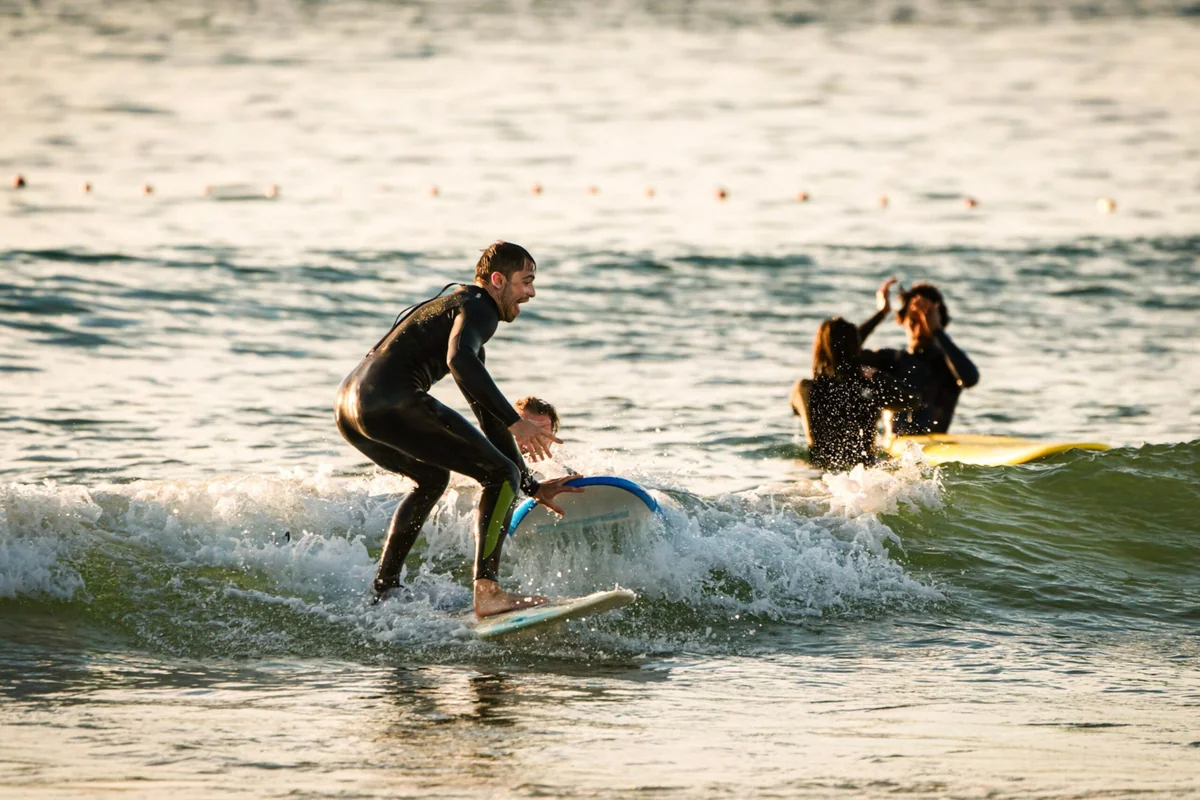
July is the social heart of the surf camp calendar. The camps fill up, the beaches come alive, and the atmosphere in Tamraght is warm and buzzing. The waves are small — this is the lightest swell period of the year — but small doesn't mean boring. For someone learning to surf, small and consistent is exactly what you want: room to make mistakes, easy paddling out, waves that are patient enough to let you work on your technique without punishing every error.
Trade winds can gust in the afternoon and chop up the surface. Go out early — the hour or two before the wind picks up is often the best surfing of the day. The water is flat, the waves are clean, and there are almost no other people in the lineup.
Water: 22–24°C | Air: 28–32°C | Wetsuit: Rash vest only | Best for: Beginner, social surfers
August — High Season
August is the warmest and busiest month. The water peaks at around 23–25°C — warm enough that you barely notice it. Swell is at its annual minimum, and the lineups on popular breaks can get crowded in the middle of the day. The workaround is the same as July: get in the water early, before the wind picks up and before the crowds arrive.
For absolute beginners, August is excellent. The physical conditions couldn't be more forgiving. You'll be surfing alongside a mix of other first-timers, which creates a relaxed, non-intimidating environment to learn in. Just know that if you're an intermediate surfer looking for wave quality, August will feel lean.
Water: 23–25°C | Air: 30–33°C | Wetsuit: Rash vest only | Best for: Beginner
September — The Return
September is when the coast wakes up again. The summer crowds thin out after the first week — most people are back at school or work — and the first hints of autumn swell begin arriving from the North Atlantic. Early September still feels like summer; by late September, you can feel the shift. The waves have more energy. The lineups have more room. The light changes.
The water is still warm from summer — hovering around 22–24°C — which means you're getting better waves in better weather with fewer people around. September is underrated — experienced travellers know it, and first-timers often overlook it. It is genuinely one of the best months on the calendar.
Water: 22–24°C | Air: 25–28°C | Wetsuit: Shortsuit or rash vest | Best for: All levels
October — The Highlight
October is, for many people who surf here regularly, the best month of the year. The swell has arrived properly — consistent, well-shaped, with good power and variety across the different breaks. The weather is warm and settled. The water is still holding the heat from summer (around 21–23°C). The crowds are low. Prices are shoulder-season.
Point breaks like Mysteries and the outer sections of Banana Point start producing longer, more rewarding rides. The beach breaks are excellent for intermediates wanting to push into steeper sections. If you can only come once a year and you want to time it well, October is the answer for most people above beginner level.
Water: 21–23°C | Air: 23–27°C | Wetsuit: 3/2 (mornings), shortsuit (afternoons) | Best for: Intermediate, Advanced (also good for confident beginners)
November — Autumn Deepens
November is a proper autumn month — the swell is building toward winter strength, the crowds are minimal, and the weather has cooled to pleasant rather than hot. Air temperatures sit around 20–23°C, the water cools to around 19–21°C, and a 3/2 becomes standard. The beach breaks near Tamraght are frequently excellent, and the point breaks start firing on bigger swells.
Intermediates find November particularly rewarding — conditions that push you without being overwhelming, with almost no one else in the lineup. For beginners, the dynamic shifts: when November swells arrive with power, coaches redirect to the more sheltered options along the coast. The quiet pace of Tamraght in November has a particular appeal — there's space to focus on surfing rather than navigating a busy camp environment.
Water: 19–21°C | Air: 19–23°C | Wetsuit: 3/2 | Best for: All levels (different spots per level)
December — Winter Returns
December brings the winter swell back in force. There are days in December that look like the best of February — powerful, clean, long-period lines stacking up on the point breaks. There are also days of onshore wind and variable conditions between storm systems. The month is more changeable than the heart of winter, but when it's on, it's exceptional.
The camps quieten down significantly in December after the first week — one of the lowest-crowd months of the year, at some of the best prices. For experienced surfers, the second and third weeks of December are a genuine hidden window. For beginners, December works by the same logic as January and February: coaches select sheltered spots that remain consistent regardless of the larger swell environment. The water sits around 18–19°C — a 3/2 is essential.
Water: 18–19°C | Air: 17–21°C | Wetsuit: 3/2 or 4/3 | Best for: All levels (different spots per level)
Quick Reference: Season Summary
| Month | Swell | Water | Wetsuit | Best For |
|---|---|---|---|---|
| January | Strong, powerful | 17–19°C | 3/2–4/3 | Beginner*IntermediateAdvanced |
| February | Strong, best shape | 17–18°C | 3/2–4/3 | Beginner*IntermediateAdvanced |
| March | Easing, still solid | 18–20°C | 3/2 | BeginnerIntermediateAdvanced |
| April | Reliable, good shape | 19–21°C | 3/2 / Shortsuit | BeginnerIntermediateAdvanced |
| May | Moderate, consistent | 20–22°C | Shortsuit | BeginnerIntermediate |
| June | Small, clean | 21–23°C | Rash vest | BeginnerIntermediate |
| July | Small, consistent | 22–24°C | Rash vest | Beginner |
| August | Smallest of year | 23–25°C | Rash vest | Beginner |
| September | Building, warm water | 22–24°C | Shortsuit | BeginnerIntermediateAdvanced |
| October | Consistent, excellent shape | 21–23°C | 3/2 / Shortsuit | IntermediateAdvanced |
| November | Strong, building | 19–21°C | 3/2 | Beginner*IntermediateAdvanced |
| December | Strong, variable | 18–19°C | 3/2–4/3 | Beginner*IntermediateAdvanced |
* Beginner sessions in winter months use coach-selected sheltered beach breaks, not the main point breaks.
Wind: The Factor People Underestimate
Swell is obvious — people think about waves first. But wind is equally important to the quality of what you actually surf, and it follows patterns that are worth understanding before you arrive.
Morning Offshore — the Magic Window
For most of the year, the early morning produces the cleanest conditions. An offshore breeze — blowing from land out to sea — smooths the waves and creates the clean, crisp conditions you see in surf photography. In spring and autumn, this window can last until 10 or 11 in the morning. In summer, the offshore often gives way to an onshore trade wind by mid-morning.
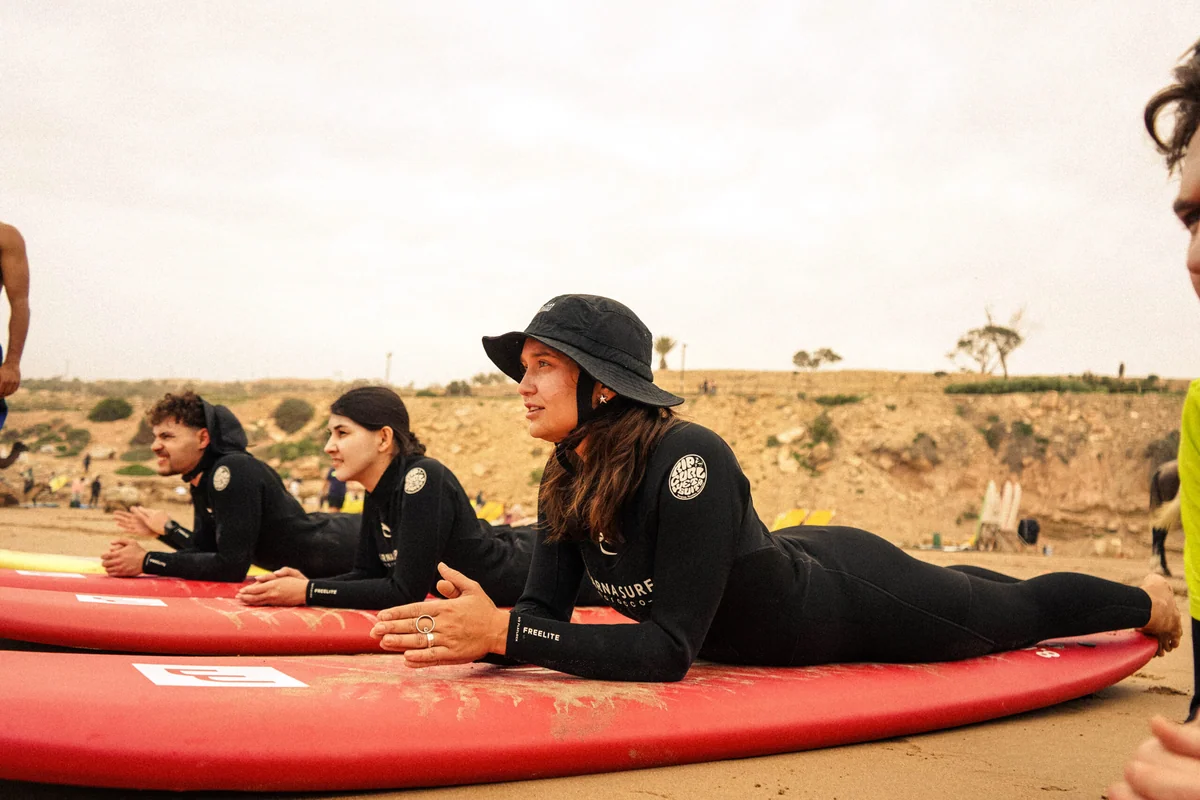
This is why every session at Darna starts early. The first session of the day is almost always the best one, and it's worth getting out of bed for.
Afternoon Onshore — When to Rest
Through July and August especially, the afternoon brings a northerly trade wind that blows onshore and textures the wave surface. It doesn't make surfing impossible, but it makes it messier and harder — particularly for beginners trying to read the break. The standard approach: surf the morning, rest and eat through the hottest part of the afternoon, consider a late-afternoon session if the wind drops before sunset.
Winter Wind
Winter winds are less predictable but often produce the most dramatic conditions when the timing aligns. A clean northwest swell arriving on a still or offshore morning in January or February can deliver some of the best surfing this coast has to offer. When it's on, it's properly on.
Crowds and Prices Through the Year
Morocco's surf season and its tourist season don't perfectly overlap, which creates some interesting windows.
Low Season (January–February, November–December)
The winter months have the best waves for experienced surfers and the fewest people everywhere. Lineups are uncrowded, prices at camps are lower, and Tamraght has a quiet, unhurried energy. For beginners, winter is the least obviously appealing season — cold water, shorter days, a proper wetsuit essential — but it's a legitimate option for anyone who prefers calm and quiet over the social buzz of summer, and whose coach selects appropriate spots for their level.
Shoulder Season (March–May, September–October)
These are the sweet spot months — the windows where conditions, cost, and comfort align. Swell is consistent and well-shaped, the weather is pleasant, prices are reasonable, and the lineups have space. If you have flexibility on dates and you're trying to get the most out of a week in Morocco, April–May and September–October are where to look first.
High Season (June–August)
Summer is when the camps fill up and the beaches get busier. Prices reflect the demand. The waves are smaller, which is fine if you're a beginner — and the social atmosphere is at its best. People arrive, connect quickly over shared meals and sessions, and leave with contacts from across Europe. If the surf is secondary to the experience, summer has a lot going for it.
Our Honest Recommendation
Here's how we'd actually answer the question "when should I come?" depending on who's asking:
- Complete beginner — ideal conditions: April–June is the easiest window. May is the standout — good waves, warm enough, not yet crowded, and the conditions at the main beach breaks actively help you learn. Summer works well too. Read our beginner's guide to surfing Morocco for a full breakdown of what to expect.
- Complete beginner — any time of year: Darna works with beginners in every month. In winter, your coach selects sheltered beach breaks where conditions remain learnable regardless of what the Atlantic swell is doing elsewhere. If December or January are your only available dates, that's a valid trip — just prepare for cold water and shorter days.
- Intermediate surfer: October, without question. Consistent swell, excellent shape, warm water, almost no crowds. If October doesn't work, April is the spring equivalent.
- Advanced or experienced surfer: February is the peak of winter swell and produces the best waves of the year at the point breaks. January is close. If you want power and perfection and you can handle the cold, February is the target.
- Families or mixed groups: July or August. The smaller waves and warm water make it accessible for people at very different skill levels, and the social energy of summer camps means everyone has a good time even when the surf is small.
Frequently Asked Questions
Do I need a wetsuit in Morocco?
It depends on the season. June through September, a rash vest or shortsuit is enough — the water is warm. From October through May, you'll want a 3/2 fullsuit, and in the coldest months (December–February) a 4/3 is more comfortable. All wetsuits are provided at Darna — you don't need to pack one.
Can beginners surf in Morocco in winter?
Yes. At Darna, we work with beginners in every month of the year, including winter. In winter, your coach will choose a spot that is right for your level — usually a sheltered beach break rather than the main point breaks. The waves at these spots are manageable for beginners even when the bigger breaks are very active. What is different in winter: it is colder (a 3/2 wetsuit is essential), the camp is quieter, and you will probably have more personal attention from coaches. If you are considering a winter trip, get in touch and we can tell you exactly what to expect.
Is Morocco good for surfing in summer?
Yes, for the right surfer. Summer delivers small, clean, warm conditions that are ideal for beginners and genuinely fun for casual surfers who enjoy the social side of camp life. If you're an intermediate or advanced surfer chasing quality waves, however, summer is the leanest season and you'd be better served by autumn or spring.
What's the water temperature in Morocco?
It ranges from around 17–18°C in the coldest winter months (January–February) to a peak of 23–25°C in August. The Canary Current keeps the water cooler than you might expect for a destination this far south — it's significantly colder than the Mediterranean, which is why a wetsuit is part of the kit for most of the year.
How far in advance should I book?
For peak weeks — late September into October, April–May, and July–August — booking 2–3 months ahead is sensible. The shoulder months have more availability, but good camps fill up regardless. If you have specific dates in mind, the earlier the better.
Ready to Plan Your Trip?
The timing piece is the one most people spend the longest figuring out — and now you have the full picture. Whatever month you're considering, there's a version of Morocco that works. The question is matching the right month to the right expectations.
If you're planning a first trip, our complete Morocco surf camp guide covers everything else you need to know: what to expect from a camp, what to pack, how the days are structured, and what Tamraght is actually like. If you're ready to look at specific packages, see what's available at Darna — and if you have questions about whether a particular week works for your level, get in touch directly. That's exactly the kind of conversation we're here for.